Optimization: Using appropriate tags, compelling thumbnails, and engaging titles.
Promotion and Growth:
SEO Practices: Optimizing video descriptions, tags, and titles for search.
Cross-Promotion: Sharing videos on social media platforms and real estate websites.
Collaborations: Working with other real estate agents, influencers, or industry experts.
Tools and Resources
Video Editing Software: Adobe Premiere Pro, Final Cut Pro, DaVinci Resolve, iMovie.
Graphic Design Tools: Canva, Adobe Spark.
YouTube Analytics: Use YouTube Studio to analyze performance metrics.
SEO Tools: TubeBuddy, VidIQ for optimizing video content.
Tips for Success
Consistency: Maintain a regular posting schedule to keep your audience engaged.
High-Quality Content: Focus on delivering informative and visually appealing content.
Engage with Audience: Respond to comments and engage with viewers to build a community.
Stay Updated: Keep up with real estate trends and incorporate them into your videos.
By following these steps, you can effectively analyze successful real estate channels on YouTube and apply those insights to create your own compelling real estate videos.
The fastest way to learn real estate video is not a course — it is reverse-engineering the channels already winning. Every successful real estate page on Facebook is a free masterclass in what your local audience responds to. Here is the systematic way to “hack” those channels and turn their lessons into your own content plan.
Step 1: Identify the Channels Worth Studying
Search Facebook for real estate pages in markets like yours (similar size, similar buyer profile — a Miami luxury page teaches you little about the Panhandle). Shortlist the ones with consistent engagement: comments and shares, not just likes. Five to eight pages is plenty. Follow them and turn on notifications so you see what they publish and when.
Step 2: Analyze the Content, Not Just the Polish
For each page, catalog what they actually make:
Video types: property tours, market updates, buyer/seller tips, neighborhood spotlights, day-in-the-life. Which types earn the most engagement?
Length: are their winners 45-second clips or 8-minute tours? Short teaches hooks; long teaches storytelling.
Production quality: resolution, angles, lighting. You will notice quickly that engagement follows personality and usefulness more than gear.
Editing style: captions and text overlays (most Facebook video is watched muted — overlays are not optional), transitions, music choice, pacing.
Step 3: Steal the Engagement Strategy Too
Content is half the game; behavior is the other half. Track their posting frequency (daily? three times a week?), when they post, how fast they answer comments, whether they go live, and how they caption (question captions pull comments; announcement captions do not). The pages that win treat comments as conversations — every reply trains the algorithm to show the page to more people.
Step 4: Build Your Swipe File
Keep a simple spreadsheet: link, video type, length, hook used, engagement count, what worked, what you would do differently. After 30 entries you will have your own data-backed playbook — a map of exactly what your market rewards, before you have filmed anything.
Step 5: Adapt, Never Copy
Take the formats that work and fill them with your market, your personality, and your knowledge. A “3 things nobody tells you about living in [town]” format is transferable; the specifics must be yours. Copying scripts verbatim reads fake instantly — and your local audience can tell.
Then Publish More Than You Study
Analysis is a two-week project, not a permanent hobby. The channels you are studying got good by publishing weekly for years, reading their own numbers, and adjusting. Your tenth video will embarrass you and your fiftieth will win listings — the only path between them is volume.
I use exactly this approach for my own Florida Panhandle real estate content. If you are an agent looking for a brokerage that treats marketing as a system — or you are buying or selling in the Panama City area — find me at WinWithGlen.com.
Imagine a world where your dream home is a tangible reality, not just a distant aspiration snuffed out by skyrocketing interest rates and daunting mortgage terms. In today’s fluctuating financial climate, securing a home loan can seem more like navigating a minefield than a pathway to homeownership. Traditional financing methods may no longer be the knight in shining armor we once believed them to be. What if, though, the real key to turning the lock on your new front door lies in something entirely unconventional? Welcome to the realm of creative financing – where innovation paves the way to your new home.
Now, you might be wondering, why should you care about creative financing in the first place? It’s simple: Conventional wisdom often falls short when economic winds shift. Interest rates can soar, locking countless hopeful homeowners out of the market. The age of rigid financial routes is rapidly fading, replaced by a more nimble and adaptive mindset. Out-of-the-box strategies can help you sidestep the financial pitfalls that have ensnared others, freeing you from the constraints of traditional borrowing. Imagine cutting through the red tape, bypassing insurmountable interest rates and perhaps even securing more favorable terms that conventional loans dare not offer. This isn’t wishful thinking; it’s a viable solution you can’t afford to overlook.
In a world where traditional home-buying methods often feel more like shackles than stepping stones, creative financing emerges as a beacon of opportunity, enabling you to transcend the limitations of conventional pathways. Imagine unlocking the door to your dream home without being weighed down by oppressive interest rates or restrictive mortgage terms. By exploring alternative avenues such as seller financing, lease options, and hard money loans, you can transform your vision of homeownership into a vibrant reality. It’s time to embrace this innovative approach and take control of your financial future. Don’t let traditional barriers stand in your way any longer—dive into the world of creative financing today and unlock the potential of your dream home. Ready to begin your journey? Contact us now to explore the myriad possibilities that await you!
As you delve deeper into the world of creative financing through this blog, prepare to uncover practical insights and actionable advice. This isn’t just another guide filled with textbook jargon and pie-in-the-sky promises. It’s a roadmap, meticulously crafted to help you navigate the maze of modern home buying. Each innovative method we explore is a potential doorway to your new residence, a key to unlocking opportunities once obscured by outdated financial doctrines. Whether you’re a first-time homebuyer or looking to upgrade, understanding and harnessing creative financing strategies could redefine your approach to the real estate market. So, buckle up and read on – your dream home is closer than you think. When interest rates are high, buying a home can feel increasingly out of reach for many prospective homeowners. However, creative financing options can provide viable pathways to homeownership even in a high-interest-rate environment. One such option is seller financing, where the seller assumes the role of the lender. Instead of securing a traditional mortgage, the buyer makes direct payments to the seller, often with more flexible terms and interest rates than those offered by conventional lenders. This approach can be mutually beneficial, giving buyers access to more affordable monthly payments while sellers might receive a higher overall return through interest.
Another effective strategy is the use of adjustable-rate mortgages (ARMs). Unlike fixed-rate mortgages, ARMs have interest rates that can change periodically, typically offering lower initial rates compared to fixed-rate loans. This can make monthly payments more manageable in the short term, allowing buyers to secure a home even when rates are high. Buyers should, however, be cautious and informed about the potential for future rate increases and ensure they have a solid financial plan in place to handle any possible adjustments. In addition, leveraging options like rent-to-own agreements or tapping into home equity through a line of credit can provide additional financial flexibility, making homeownership more attainable in a fluctuating interest rate landscape.
Changing brokerages is a common decision that real estate agents have to make at some point in their careers. But how do you choose the right brokerage? In this blog post, we will discuss some important factors to consider when making this decision.
First and foremost, it’s important to remember that the ultimate goal of a real estate agent is to sell houses. So, when choosing a brokerage, it’s crucial to focus on finding one that aligns with this goal. This means looking for a brokerage that prioritizes the success of its agents in selling houses, rather than focusing on other aspects of the industry like recruiting agents or earning revenue share.
One important factor to consider is whether the brokerage is agent-centric or broker-centric. An agent-centric brokerage allows agents to build their own brand identity, while a broker-centric brokerage may require agents to adhere to strict branding guidelines. It’s important to determine whether you have the freedom to build your own brand identity or if you must conform to the company’s brand.
Another aspect to consider is the level of support the brokerage provides for lead generation and client acquisition. Some brokerages offer extensive support in helping agents generate leads and acquire clients, while others may not provide much support in this area. It’s important to ask what type of support the brokerage offers and whether it aligns with your needs and goals as an agent.
Additionally, it’s worth considering the listing inventory of the team or brokerage. Having access to a large listing inventory can be valuable for agents, as it allows them to leverage these listings to generate more business. It’s important to find out if the team or brokerage has a significant listing inventory and whether you can use it to your advantage in securing more opportunities.
Market share is another important factor to consider. Being with a company that has a decent market share can provide credibility and confidence to potential clients. It’s worth finding out if you can leverage the company’s market share in your marketing efforts and use it to win more business.
Broker support is another crucial aspect to consider. It can be beneficial to have a broker or team leader who is actively involved in the business and has experience in selling real estate. Having someone who understands the challenges and intricacies of the industry can provide valuable support and guidance.
Lastly, office presence can also play a role in the perception of potential clients. While it may not be necessary for agents to physically go to the office, having a visible office presence in the market can provide a sense of credibility and professionalism. It’s worth considering whether the brokerage has a strong office presence in the areas you operate in.
In conclusion, choosing the right brokerage is an important decision for real estate agents. By considering factors such as agent-centric vs. broker-centric culture, lead generation support, listing inventory, market share, broker support, and office presence, agents can make an informed decision that aligns with their goals and helps them succeed in selling houses.
Title: The Importance of Office Presence and Commission Structure in Real Estate Brokerages
When choosing a real estate brokerage, it is crucial to consider factors such as office presence and commission structure. In this blog post, we will discuss the significance of having a physical office space that exudes professionalism and creates a positive impression on clients. Additionally, we will explore the debate surrounding commission splits and highlight the importance of focusing on the value provided by a brokerage rather than solely considering the commission percentage.
The Importance of Office Presence For real estate agents who opt for brokerages with physical office locations, it is essential to select a brokerage that offers an impressive and professional atmosphere. A well-maintained office space can leave a lasting impact on clients and create a sense of trust and credibility. When clients visit an office that exudes luxury and quality, it enhances their perception of the agent and the brokerage. Although it is challenging to quantify the value of an impressive office space, its intangible benefits are undeniable.
Commission Structure and Value Many agents prioritize commission splits when choosing a brokerage. However, it is crucial to consider the value provided by the brokerage rather than solely focusing on the commission percentage. Price is what you pay, but value is what you get. To illustrate this point, let’s consider two scenarios:
Scenario 1: 50/50 Split with Extensive Support Imagine joining a brokerage with a 50/50 commission split, where the brokerage takes care of prospecting, lead generation, listing marketing, listing coordination, and transaction coordination. As an agent, your responsibilities would primarily involve attending listing appointments, closing deals, and getting paid. Under this model, you generate $400,000 in Gross Commission Income (GCI), resulting in a $200,000 income. This scenario allows you to focus on your core tasks and achieve a substantial income without working nights or weekends.
Scenario 2: 100% Commission with Self-Reliance Alternatively, you could choose a brokerage that offers a 100% commission split, allowing you to keep all your earnings. However, in this case, you would be responsible for generating your own business, including prospecting, lead generation, marketing, and client services. Agents operating under this model often struggle to maintain a consistent flow of business, resulting in an average of six deals per year and an income of $40,000. This scenario requires agents to handle all aspects of their business, leading to increased workload and limited earning potential.
Choosing the Right Option: Considering the two scenarios presented, it becomes evident that the value provided by a brokerage goes beyond the commission split. While a higher commission percentage may seem appealing, it is essential to evaluate the support and resources offered by the brokerage. Opting for a brokerage that provides extensive support can significantly impact an agent’s income and work-life balance.
When selecting a real estate brokerage, it is crucial to consider factors such as office presence and commission structure. An impressive office space can create a positive impression on clients and enhance an agent’s credibility. Additionally, focusing on the value provided by a brokerage, rather than solely considering the commission split, can lead to higher income and a better work-life balance. By prioritizing both office presence and commission structure, agents can make an informed decision that aligns with their professional goals and client expectations.
Today’s topic about sharing my thoughts about the market. Please be advised these are not any financial advice.
The whole email is about what I think has been happening for the last couple of years and whats going to happen next.
Its going to take you 3 mins to read.
“No, if you show revenue, people will ask ‘How much?’ and it will never be enough. The company that was the 100xer, the 1,000xer, becomes the 2x dog. But if you have no revenue, you can say you’re pre-revenue. You’re a potential pure-play. It’s not about how much you earn. It’s about how much you’re worth. And who’s worth the most? Companies that lose money.”
Hence today’s topic about financial freedom:
If your asset doesn’t do anything, it can be anything you want it to be.
For the last two years, market participants have been playing a fun game called “red line , green line.”
The rules of this game are pretty simple:
Buy stuff when its red.
Watch the line goes to green.
Make money.
Repeat.
Which lines went up the most? Growth stocks. Meme stocks. Crypto. NFTs etc. The more ridiculous the valuation, the wilder the story, the higher the line went.
After all, commission-free trading + historically low interest rates + fastest market crash in history + pandemic-induced lockdowns + trillions in quantitative easing + millions of bored people turning to the market for entertainment created one hell of a financial cocktail.
When there are trillions of dollars sloshing around, why wouldn’t you throw money at anything and everything? Right? Right? It’s like a giant game of hot potato – only with real money.
Just like any other game, as the game progressed , the pieces evolved. As more and more people started playing Red line , green line, the game grew more insane.
People were paying $500k for a JPEG? That doesn’t even make sense.
But like all other games, there is an endgame. The problem is, most players did not realize they were all a part of the game. They thought it was investing.
They assumed that good stories are making the line goes green, that their assets are growing more valuable. But this assumption isn’t true.
The stories didn’t make the assets more valuable. The stories gave others a contagious case of FOMO. And when other people who were not playing red line , green line they fomod in for fun because no one wants their friends to get rich without them. The more people fomod in , the line went green, the people who were playing the game , they sold some of their assets for a profit, hence the line became red.
So now half of the players thought their assets are valuable, and the other half felt like they were missing out. And this cycle went on for a while, especially when everyone had money to blow.
But what happens when that money starts to disappear?
For the past few years, it’s felt like everything has been going to the moon. Stock prices were skyrocketing, crypto was booming, and everyone wanted a piece in it.
Fast forward to May 2022.
Prices are crashing, inflation is real, gas is expensive, and layoffs are becoming more common.
In times like these, people have to make tough decisions with their money. And for the players who thought they were investing in something real, it’s a harsh reality check. They’re learning that their “assets” weren’t nearly as valuable as they thought. But for the players who knew it was all a game, they’re already planning their next move.
You can explain the potential use cases, road maps, and pitch decks all you want, but if it comes down to putting food on your table or NFTs in your wallet, you are going to choose the former so that your family can eat.
The internet is a funny place. It’s a place where you can be anyone you want to be, and where you can do anything you want to do. It’s a place where you can build entire worlds from scratch, and where you can destroy those same worlds with a few clicks of a button. It’s a place where fantasy and reality collide, and where anything is possible.
So what comes next? That’s the million dollar question. Most likely we’ll see a lot of consolidation and contraction in the industry as people realize that they can’t keep up the charade any longer. But there will also be opportunities for those who are smart and nimble enough to take advantage of them.
So whatever you do, don’t panic. This too shall pass. And when it does, those who are prepared will be ready to profit.
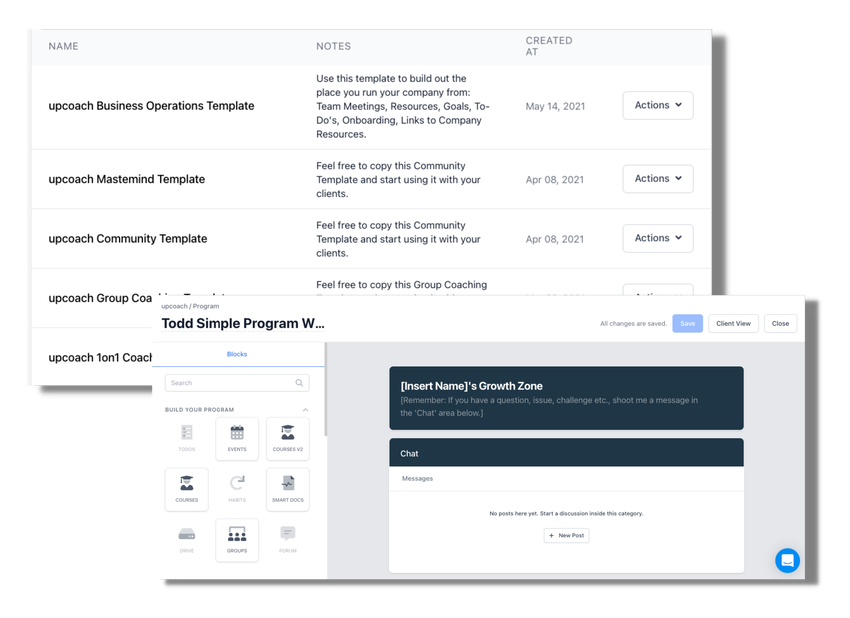
Upcoach is a modern transformation platform that lets you build and manage your coaching program with courses, chat, meetings, and tasks.
With upcoach, you can house all your courses and training for individual or group coaching programs to transform the lives of your clients.
Create courses with multiple modules and lessons. You can even choose the pace for completing each course by making it all available at once or dripping it out over time.
You’ll be able to assign interactive worksheets, to-dos, and new habits alongside the training so they’re not just downloading PDFs or copying Google Docs.
Create courses and assign to-dos, habits, and worksheets to ensure clients are learning and staying engaged.
Upcoach lets you build out your program with a drag-and-drop editor, so you can create your own no-code layout.
Use a template or create a program from scratch based on your unique needs and program structure.
You’ll be able to build a variety of program types, including one-on-one programs, group programs, cohorts, and masterminds.
It’s super easy to lay everything out for your program using the drag-and-drop editor.
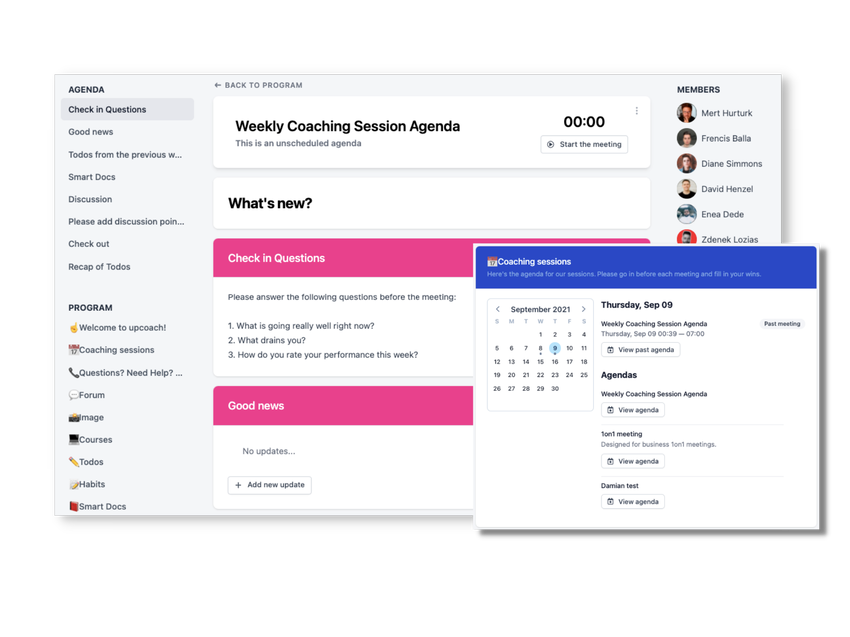
You can organize and schedule your meetings, as well as see an overview of all past and upcoming meetings, on the Events Calendar to avoid any scheduling conflicts.
Create a meeting agenda from scratch or use a premade template to keep your meetings or events running smoothly. This also gives your clients a place to ask questions and collect wins.
Upcoach also lets you connect meeting agendas to your Google calendar and add a Zoom link to invites, so clients can join meetings with the click of a button.
Keep everyone on the same page by organizing and scheduling meetings with agendas, right from the platform.
With upcoach, you’re able to track any client’s progress and engagement using a Kanban board—making this more than a passive consumption system.
Keep up with client progress using to-dos, habits, and worksheets, so they can implement what they’ve learned in the course and during coaching sessions.
You can also encourage social accountability and add motivation by allowing members to see each other’s commitments.
And because communication is so important for community-building, upcoach lets you chat with clients using one-on-one, group, and admin chat features.
Track client progress with to-dos, habits, and worksheets that help them stay motivated!
In order to help your clients meet their goals, you need a platform that helps you achieve all of yours. (“Goal #1: Be the best coach in the game. Goal #2: Get eight hours of sleep per night.”)
Upcoach houses all of your courses, training, to-dos, groups, and communication history, so you can focus on what you do best—helping your clients flourish.
Scale your coaching program with ease.
This review is provided by Appsumo, on of the leading marketplaces for software deals.
Get ready, marketers. We’re changing the way you work.
What if you could create and add video to your Facebook ads, Instagram posts, and media library directly within Meta Business Suite? No more managing workflows across multiple tools. Plus, say goodbye to downloading video assets from other apps and re-uploading over and over.
We’ve combined the firepower of Meta with what we do best — ya know, video — to build a first-of-its-kind conduit for businesses and creators to access tools they need to generate content across Facebook and Instagram. With Meta Business Suite x Vimeo, you can create, customize, and schedule content within a single platform. The result? An intuitive, ready-in-minutes workflow designed for easy content creation and distribution.
Go ahead and close the tab on your post scheduler and content calendar. (We dare you.)
Here’s how you can use the Vimeo x Meta experience to create relevant content in just a few minutes with easy templates, or plan out your social media calendar weeks in advance.
How to create a post using Meta x Vimeo (in 4 steps!)
Looking to create a post for Facebook or Instagram, but need some inspiration? Here’s how to use Vimeo within Meta Business Suite for your next big social push.
When creating a post to publish to your page, you’ll see an option to add media.
Select “Use template” to browse Vimeo templates across dozens of categories like Facebook Ads, Reels, Marketing videos, and more.
Start building your video by adding your logo and brand info, animated stickers, music, filters, and more. Click “Save & preview,” and voila! You now have a scroll-stopping post made in mere minutes.
Add your call-to-action, caption, and publish directly to Facebook or Instagram!
How to plan your social media calendar using Meta x Vimeo
You don’t need an actual production team to make a calendar’s worth of social videos for your biz. With Vimeo x Meta, you have a virtual production team at your service.
Here’s how to get strategic with planning video posts for holidays, big moments, and timely occasions you might not know about.
Within the Meta Business Suite Planner, you’ll immediately see a calendar view, complete with upcoming holidays and events.
On the right side, choose an upcoming Moment that will resonate with your audience, then click “See templates.”
Browse dozens of customizable Vimeo templates pre-designed for your exact use case — whether that’s a holiday promo video or a marketing video ad.
Caitland is a content strategist at Vimeo. She’s passionate about writing, helping small businesses grow their marketing, very foamy cappuccinos, and her elaborate WFH skincare routine.
how you can post in your groups as admins and moderators under the group name or any (collective) name.
1) Create a Facebook Page with the name you want (e.g. the group’s name, group name admins, group name team, moderator team or whatever you prefer). You only have to enter a few basic information. You can find out how to do this here: https://www.facebook.com/business/help/473994396650734
2) Now invite your group admins, moderators, etc. to like the newly created Facebook Page.
3) Assign them an appropriate role (admin, editor, etc.) on the new Facebook Page. All admins, editors, and moderators of your newly created Page can then post to the group under the Page name.
4) In the group settings, the “People and pages” option must now be activated in the “Member management” area. You can find out how to do this here: https://www.facebook.com/help/329227454611442
There are now two ways to connect the page and the group:
You can link the page directly to the group in the group settings. But beware! The page is then automatically the administrator of the group with all rights.
Sign up for our brand new 14-day Credit Hero Challenge: http://creditherochallenge.com/
No matter what you do in life…
Timing is pretty important.
Doesn’t matter if you’re approaching a girl or boy… telling a joke… or helping clients improve their credit repair.
Timing can be the difference between you achieving all the goals you set out for your credit repair client… or falling short of them and never quite making it.
But in today’s episode, I’m gonna hold you by the hand and teach you how you can deal with timing in credit repair. To do this, I’m going to teach you the ‘Credit Repair Clock’ method that we use!
This one method has helped us to remove countless negative items from clients’ credit reports over and over again, improving thousands of credit scores in the process.
Oh and best of all… it’s super easy to implement.
We’re gonna teach you what this method is, how incredibly easy it is to follow, and how to apply it for the best possible results for your clients.
Make sure to check it out!
Key Takeaways:
Intro: (00:00)
How one credit hero has so many clients he can’t keep up (03:00)
What is the Statute of Limitations? (04:06)
A common myth about credit report items (05:24)
What you gotta know about timing (07:13)
Episode wrap-up (10:34)
#DanielRosen #CreditRepair #CreditClock
Be sure to subscribe to the podcast at: https://www.creditrepaircloud.com/podcast
–
Facebook: https://www.facebook.com/creditrepaircloud/
Instagram: https://www.instagram.com/crc_heroes/
–
Check out the FREE digital download mentioned in the episode:
https://www.creditrepaircloud.com/timeclock
–
Get your FREE trial of the Credit Repair Cloud software at: https://www.creditrepaircloud.com/freetrial
#businesscoachonline #creditrepair #fixmycredit
Sign up for our brand new 14-day Credit Hero Challenge: http://creditherochallenge.com/
Starting a credit repair business has never been easy.
I mean you can get set up, market your services and get your first clients… but by that stage, you haven’t even done the hard work yet!
You still have to get results for your new clients!
So in today’s episode, we’re going to teach you everything that you need to know in order to turn your credit clients into credit geniuses.
If you want to make your clients into credit Einsteins… then this is what you need.
The top 7 tips you need to know in order to maximize results for your credit repair clients are right here!
Make sure to check it out!
Key Takeaways:
Intro (00:00)
How one Texas nurse is starting her own credit storefront (02:07)
The 7 tips to pass on to your clients (03:42)
Why you have to pay your bills on time (04:22)
Why you shouldn’t make big promises to clients (05:28)
Should you show this video to your clients? (06:55)
Episode wrap-up (09:46)
#CreditRepair #DanielRosen #CreditHero
Additional Resources:
Be sure to subscribe to the podcast at: https://www.creditrepaircloud.com/podcast
–
Facebook: https://www.facebook.com/creditrepaircloud/
Instagram: https://www.instagram.com/creditrepaircloud/
–
Get your FREE trial of the Credit Repair Cloud software at: https://www.creditrepaircloud.com/freetrial
#businesscoachonline #creditrepair #fixmycredit