Category: Success Series

  • The Success Series: 12 Motivational Talks Worth Your Time

    Between 2016 and 2022 I shared the talks and interviews that genuinely changed how I think about success — Eric Thomas, Ed Mylett, Joe Dispenza, Cesar Millan, and more. They used to live scattered across a dozen posts; this page collects the whole Success Series in one place, each with the idea that made it worth sharing.

    Eric Thomas — The Hip-Hop Preacher

    No one delivers urgency like ET. A critically acclaimed author, world-renowned speaker, and pastor, Eric Thomas built his message from lived experience — and it lands every time.

    #MaxOut with Ed Mylett

    ET’s story and philosophy in one conversation: why “average” is a decision, and what it costs.

    Love Thy Haters (TGIM)

    The first voice you have to defeat is the hater in your own head. Critics are proof you’re moving.

    No Net (TGIM)

    Talent and skill don’t decide the outcome — the will to fight through each battle does. Working without a safety net isn’t recklessness; it’s commitment.

    https://youtube.com/watch?v=nBPkaBpq6u0

    Ed Mylett’s Interviews

    Eric LeGrand — Never Give Up

    From lying paralyzed on a football field to inspiring millions. If LeGrand’s outlook doesn’t reset your definition of a bad day, nothing will. Possibly the most inspirational episode of them all.

    Seth Rollins — The Raw Truth About Overnight Success

    The WWE superstar’s “overnight” success took over a decade of wrestling in gyms nobody heard of. Every overnight success story reads the same way once you see the years behind it.

    JP Sears — Emotional Healing and the Path to Happiness

    Are you sacrificing your emotional well-being for your goals? A conversation that manages to be funny and genuinely liberating about the inner work success requires.

    Mindset and Belief

    Dr. Joe Dispenza — Unlock the Unlimited Power of Your Mind

    Turn your brain from a record of the past into a map of the future. Dispenza’s framework for why we repeat old patterns — and how to deliberately rehearse new ones.

    Chris & Heidi Powell — How to Build Self-Belief

    Self-confidence is built one kept promise at a time — the promises you keep to yourself. Transformation is a mindset before it’s a result.

    The Power of Belief — Homeless at 13

    Could you imagine being homeless at 13? This story of going from the street to building a business is the purest case for belief as a practical tool, not a platitude.

    Doing It Your Way

    Cesar Millan — You Can Do WHATEVER You Want

    “It’s not where you are at today or where you came from, but where you will be at tomorrow.” A true rags-to-riches story from the world’s best-known dog behavior expert.

    Tiffaney Malott — How to Overcome Struggles

    A grounded conversation about pushing through the seasons where nothing seems to work — and why those seasons are usually the setup for the breakthrough.

    5 Principles to Live a Happy and Successful Life

    The one skill successful people share, plus four principles that compound: honor yourself, and do the things you said you would do.

    The Thread Through All of It

    Different speakers, one message: success is decided in the unglamorous moments — the promises you keep to yourself, the years before anyone notices, the voice in your head you choose not to believe. Motivation starts the engine; habits drive the car.

    And when the mindset work meets a real opportunity — a business to start, equipment to buy, a deal to close — the next constraint is usually capital. That part I can help with directly: Funding-Advisor.com is where I show business owners what funding they actually qualify for.
  • Break Mental Barriers – David Goggins

    WIN The War In Your HEAD And Find PEACE

    What does the TOUGHEST MAN ALIVE have to say about suffering? Victory in Suffering – With David Goggins You have been asking to see David and I together and that day has finally arrived! This interview is intense and we dig very deep into a variety of topics. It’s even better than you probably can imagine! (Very strong and adult language warning!)

    David Goggins, author of best-selling book Can’t Hurt Me – is the only member of the U.S. Armed forces to complete Seal Training (including 3 hell weeks), the U.S. Army Ranger School and Air Force Tactical Air Controller Training. He is the EPITOME of pushing the limits!

    There wasn’t just one breakthrough that course-corrected Goggins’s life forever, but in this episode, we take a deep dive into the accumulation of moments that ended up cultivating the mindset needed to become the toughest man alive! Accountability is everything. What are you telling yourself in the mirror every day?

    Are you living up to your full potential? Quitting is a choice. Taking the path of least resistance is a choice. But you can never lie to yourself, you always know when you aren’t being the person you know you can be and there’s only ONE thing that’s getting in between you and the YOU that you know you can be… MINDSET!

    This episode will teach you how to go down into the dungeon and fight the war with yourself. You’ll learn how to make it all the way to the finish line even when you feel as if you can’t go any further. It’s time to close the gap between just being “inspired” to actually ACCOMPLISHING your biggest dreams. Goggins reveals how you can use your suffering as a catalyst instead of an excuse to stop! What if all of your sufferings were a clear sign of you becoming stronger because you are forcing yourself to endure what you thought you never could?

  • The Importance of Leaving a Legacy

    The Importance of Leaving a Legacy

    The Importance of Leaving a Legacy

    Our lives impact all those who follow us The principles we live by are the basis for the kind of legacy we will leave behind. We will also begin our how-tos by looking at how to leave a relational legacy. All of life is based on relationships, and we choose what direction those relationships go. We can live our lives in such a way that when we are gone, people are impacted by the relational legacy we left behind.

    The core of who we are as individuals is spiritual. We were created with the intention of relating to God through our spiritual life. One of the greatest gifts we can leave behind is a spiritual example and legacy. We will also talk about how to leave a life legacy that impacts people. There are those who live on this earth and then just disappear, leaving little more than a trace. And then there are others who, through their legacy, live on in others for years to come.

    The United States’ founding fathers, who had a dream of a place of self-determination.


    Abraham Lincoln, who freed the slaves.


    Franklin Delano Roosevelt, who saw us through the Great Depression.


    The many men and women who defended our liberties through the wars of the 20th century so that we can live in freedom.


    John F. Kennedy, who called us to explore space and set us on course to have a man walk on the moon.


    Martin Luther King Jr., who left us a legacy to pursue the dream of racial equality.


    There are literally thousands of men and women who lived in a way that affects our lives today.


    And, yes, the list goes on from there as well. These are the people we knew, the people we lived with and who shaped us deeply, for better and for worse in some cases.


    You see, a legacy can be anywhere on the continuum, from very bad to very good—it  all depends on how we live our lives.


    How we live our lives is critically important. This month, I want to  challenge you to take a look at how you live. Challenge you to think deeply about the major areas of your life where you can and should leave a lasting legacy.


    . The legacy we leave is part of the ongoing foundation of life. Those who came before leave us the world we live in. Those who come after will have only what we leave them. We are stewards of this world, and we have a calling on our lives to leave it better than how we found it, even if it seems like only a small part.


    2. Legacies have raw power for good and for bad. There are people who have changed the world for good, people who have opened up new worlds for millions of others, people who have spurred others on to new heights. And, conversely, there are people who have caused massive destruction for countless millions, people who left a wake of pain behind them wherever they went. There are parents who have  blessed their children with greatness and parents who have ruined their children’s fragile minds and hearts. What we do affects others. Our lives have the power to create good or purvey evil. It is important that we choose to do good.


    3. It is an act of responsibility to leave a legacy. Because of the power of our lives and the legacies we leave, it is a great responsibility to choose to leave a positive legacy. All good men and women must take responsibility to create legacies that will take the next generation to a level we could only imagine. I truly believe that part of what makes us good and honorable people is having a foundational part of our lives based on the goal of leaving a legacy.


    4. Purposefully leaving a legacy for others breaks the downward pull of selfishness that can be inherent in us all. When we strive to leave a legacy, we are acting with a selflessness that can only be good for us. Yes, I suppose someone could work hard to earn money so that when he or she dies a building is named after them, but that is not the kind of legacy we are talking about. We are talking about legacies that make life better for those who come after us, not about our own fame or recognition, but about helping others. After all, we won’t be around to watch our legacy. To build that which will last beyond us is selfless, and living with that in mind breaks the power of selfishness that tries so desperately to engrain itself in our lives.


    5. It also keeps us focused on the big picture. Legacy building is part of the “big  picture.” It keeps us focused on the long term and gives us values that we can judge our actions by. When we are acting based on selfishness, personal expediency and the like, we are focusing on the “small picture”—whatever is pragmatic right now. When we are building a life that will give for many years, we are thinking “big picture.” Ask yourself: How does this action affect my overall goals? How will this affect people in the years to come?


  • Art of Communication

    Art of Communication

    The Fundamentals of Effective Communication

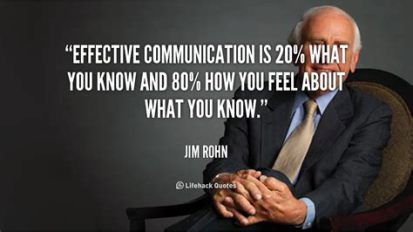
    Our very success is heavily dependent upon our ability to communicate. This is not just for professional speakers. From schoolchildren to grandparents, everyone should work on improving their communication skills so they can improve their lives. Improving your ability to communicate will be one of the most important things you ever do.


    One of the easiest ways to improve your communication is to start by solidifying your base, so to speak, by working on and improving the fundamentals. To get you started, here are a few areas that everyone should know and master.


    Communication is powerful—for better and for worse. There is a proverb in the Bible that says, “The tongue has the power of life and death.” This is true. What a person says can build people up or tear them down. The ability to communicate is a powerful responsibility. Whole nations have been inspired to action because of single individual’s passionate words. On the other hand, countless millions of children have been deeply hurt because of the derogatory words spoken to them by their parents. You have within you the incredible power of communication. You can create tremendous things in your life if you take communication seriously and use its power to help others and yourself. Combining this knowledge with a heart set on doing good is the first step in unleashing this incredible force!


    Communication must be purposeful. In order to be effective, your communication should be on purpose. Yes, occasionally you may say something off the top of your head and that can hold weight with others, but this is the exception and not the rule. In order to become an effective communicator, you should be very purposeful about your communication. Know what you want to communicate, when you want to communicate and how you want to communicate. Decide what kind of communication will enhance your life and the lives of those around you, and plan your steps for communicating in that way. And then work your plan—know what it is you want to accomplish and how must you communicate in order to do so.


    What you say must match what you do. Remember, people watch what you do, not just what you say. What you do always outweighs what you say. If you say one thing and do another, people will follow what you do. If you say something and back it up with your actions, you will provide the “proof” for people who are listening to you, and they will much more willingly follow your lead.


    Improve the “Big Two”: speaking and writing. When it comes to communication, these are the “Big Two” that everyone can improve upon: speaking and writing. For every one step that you take to increase your ability to speak and write, you will improve your career position two steps. Don’t think that you have to become the best speaker or writer in the world; just set your sights on the next level above where you are now. Once you get there, then continue to work to the next level.


    Here are a few tips for becoming a better speaker and writer:


    Becoming a better speaker:

    – Join Toastmasters.

    – Take a college course on public speaking.

    – Give a speech in front of a mirror.

    – Just speak—wherever you can.


    Becoming a better writer:

    – Keep a journal.

    – Join a writing club.

    – Have people who are more skilled than you help edit (and critique) your letters and e-mails.

    – Take a college course on writing.

    – Write that book you’ve been thinking about.


    Becoming a better speaker and writer will be based on three things: doing it, getting feedback and acting on that feedback.


    Learn to listen. Communication is not one direction—it goes both ways. To become an effective communicator, you must be a good listener. All of the following examples show the power of listening: the parent who listens for the feelings of his or her child; the salesperson who listens for what kind of product the client wants; the boss who listens to the concerns of his employees. Can you see how listening in those situations enables you to become a better communicator? Once you know what your “audience” wants, you will be able to better communicate to them. We covered listening skills last month in detail. I would encourage you to go back over those items until they become a natural part of you.


    Care about the people with whom you communicate. Talk with them, not to them. People don’t want you to talk at them. They want to communicate. Think about it: The root word is commune, which means to live and share together. This is what we do when we communicate together—we share words and ideas. This means we must care about the people we are communicating with. We should be interested in their needs and desires. And when we know those, we can communicate more effectively with them.


    Focus on clarity. The most effective communication is clear communication. Many beginning speakers believe that they should be as verbose as possible—but that is not what makes them effective! The important principle is clarity. Do they (the people in your audience) understand your message? That is the question. If they don’t, then you haven’t communicated. Be as clear and as concise as you can. Never go any longer than it takes to make the communication as clear as it needs to be. And, above all, make sure your audience understands your message when you are finished.


    Communicate over and over again. In order to be effective, communication must be done over and over again. The parent or boss who yells, “How many times must I tell you?” is really just proving again that people need to hear a message many times before they internalize it. That is just the difficult nature of communication. Very rarely will you be able to communicate something just once and have someone or some group walk away with full understanding. It just doesn’t happen that way. You need to do it often and in varied ways. This is what will make your communication most effective.


    Improve your vocabulary, pronunciation and spelling. When people hear you or read what you have written, they look for class and style. This can often be noticed through your vocabulary, your pronunciation and your spelling. If you want to be more effective, focus on improving in these areas. A key phrase is that our vocabulary directly affects the way we both view and interpret the world around us. If we have a small vocabulary, it limits our ability to define or communicate what we see, feel and hear. The larger the vocabulary, the better our ability to relate. What size is your view—a peephole or a huge, clear window showing the great expanse of this amazing, wonderful world we live in?


    You can become an effective communicator! Start with improving the fundamentals, and you will get better. Once you have mastered the fundamentals—and very few have—then you can start on the advanced areas and become world-class!

  • 5 Undeniable Reasons to Leave a Legacy

    Goal Setting

    1. It is part of the ongoing foundation of life.
    Those who came before leave us the world we live in. Those who come after will have only what we leave them. We are stewards of this world, and we have a calling on our lives to leave it better than how we found it, even if it seems like only a small part.

    2. It has the raw power for good and for bad.
    There are people who have changed the world for good, people who have opened up new worlds for millions of others, people who have spurred others on to new heights. And, conversely, there are people who have caused massive destruction for countless millions, people who left a wake of pain behind them wherever they went. There are parents who have blessed their children with greatness and parents who have ruined their children’s fragile minds and hearts. What we do affects others. Our lives have the power to create good or purvey evil. It is important that we choose to do good.

    3. It is an act of responsibility to leave a legacy.
    Because of the power of our lives and the legacies we leave, it is a great responsibility to choose to leave a positive legacy. All good men and women must take responsibility to create legacies that will take the next generation to a level we could only imagine. I truly believe that part of what makes us good and honorable people is having a foundational part of our lives based on the goal of leaving a legacy.

    4. It breaks the downward pull of selfishness that can be inherent in us all.
    When we strive to leave a legacy, we are acting with a selflessness that can only be beneficial for everyone. Yes, I suppose someone could work hard to earn money so that when he or she dies a building is named after them, but that is not the kind of legacy we are talking about. We are talking about legacies that make life better for those who come after us, not about our own fame or recognition, but about helping others. After all, we won’t be around to watch our legacy. To build that which will last beyond us is selfless, and living with that in mind breaks the power of selfishness that tries so desperately to engrain itself in our lives.

    5. It keeps us focused on the big picture.
    Legacy building is part of the “big picture.” It keeps us focused on the long term and gives us values that we can judge our actions by. When we are acting based on selfishness, personal expediency and the like, we are focusing on the “small picture”—whatever is pragmatic right now. When we are building a life that will give for many years, we are thinking “big picture.” Ask yourself: How does this action affect my overall goals? How will this affect people in the years to come?

    Yes, your legacy is very important. Reflect on how you are going to use the lessons, information and skills from those before you to build a life that leaves a tremendous legacy!


  • What does the word inspiration mean?

    What does the word inspiration mean?

    I look at the word and break it into two parts: “in” and “Spirit.” To live an inspired life, then, means to be “in Spirit” all the time – to be in tune with the magnificent presence of the Higher Self within you.

    Where in effect, the mind is open to everything, and attached to nothing. We are all derived from an organizing intelligence no matter what religion, nationality, or belief system, that divine spark resides within everyone even if the person is not currently aware of it.

    Therefore, this organizing intelligence is the place from which we all derive inspiration – in -spirit. An inspired life is finding a way to live in harmony with the divine intelligence with every thought you have. To live at all times in spirit and feeling yourself when you are disconnected from spirit.

    The key is being in touch with that divine source within which is inspiration. Living day in and day out, watching every thought and knowing that you have left spirit when you have a thought that does not include everyone – when you become ego centered (Edging-God-Out}

    Being inspired is about changing awareness of yourself as being limited, having no luck, things never working out, etc. into realizing that you are unlimited and have the potential to create whatever you truly desire if it is in alignment with the divine within.

    Whatever the mind of man can conceive, the mind of mind man can create. You are a perfect creation of the Divine. There is absolutely nothing that you cannot create. Have a knowing that you can create and attract to yourself anything you need to create your desires. `

    Living an inspired life is realizing that you came from a divine source – you are a piece of this divinity, an expression of unlimited potential. In truth, you are like what you came from – we are pieces of the divine. We are spiritual beings having a human experience, not human beings having a spiritual experience.

    A drop of the ocean is not the ocean, but the small drop has the same qualities and essence of .the ocean.. Since the source from which we came is love, peace, abundance, unlimited, perfect health, then we also have these qualities inherent in us as humans. It is actually an insult from which you came to think anything less.

    We came into existence from divinity but somehow got separated from our source and developed an ego. We began to follow the herd and to identify with accumulating things. Quiet your mind, meditate, and get back in touch with your Higher Self.

    When you are inspired, you discover yourself to be a greater person than you ever imagined. Realize that your thoughts are energy. It’s all about what kind of thoughts and feelings we offer up to achieve our desires which are aligned with Spirit.